Bringing a new sectional sofa into your home can transform your living space, offering unparalleled comfort and style. However, the excitement of choosing the perfect piece can quickly turn into frustration if it doesn’t fit through the door or overwhelms your room. With over a decade of experience in interior design, especially with sofas, I’ve learned that precise measurement is the cornerstone of a successful sectional sofa purchase. This guide will walk you through a detailed, DIY approach to measuring your room, ensuring your new sectional enhances your home beautifully and functionally.
Why Accurate Measurement is Your Best Ally
Investing in a sectional sofa requires more than just picking a design you love; it demands careful planning to ensure it seamlessly integrates into your home. Accurate measurements are crucial to avoid common pitfalls like a sofa that’s too large for the room, blocks essential walkways, or cannot even make it past your front door. Proper planning guarantees not only a perfect fit but also a harmonious flow and optimal comfort within your living area, preventing costly returns and dissatisfaction.
Essential Tools for DIY Room Measurement
Before you begin, gather a few simple tools to ensure accuracy and ease throughout the measuring process. These will be your best companions in envisioning your new sectional.
- Tape Measure: A retractable steel tape measure, preferably one that extends beyond 15-20 feet, is indispensable for all your length, width, and height measurements.
- Graph Paper and Pencil (or Digital Layout Planner): Sketching your room and proposed sectional layout on graph paper or using a digital tool will help visualize the space and identify potential issues.
- Notebook and Pen: For jotting down all your measurements and any important notes.
- Painter’s Tape: This non-damaging tape is a game-changer for outlining the sectional’s footprint directly on your floor, allowing you to “see” how it will fit in real-time.
Step-by-Step Guide to Measuring Your Room for a Sectional Sofa
Follow these steps carefully to ensure every aspect of your room and potential sectional is accounted for.
Step 1: Map Your Space and Identify Obstacles
Table is empty.Start by getting a comprehensive understanding of your living room. A simple sketch of your room on graph paper, noting the location of windows, doors (and their swing directions), radiators, power outlets, vents, and any built-in features like fireplaces or pillars, is incredibly helpful. Also, mark any existing furniture you plan to keep to visualize how the sectional will interact with it. Consider the natural pathways people take through the room.
Step 2: Record Overall Room Dimensions
Next, measure the room’s overall dimensions. Use your tape measure to find the total length and width of the room from wall to wall. Don’t forget to measure the ceiling height, especially if your sectional has a tall back or will be tilted during delivery. These numbers provide the foundational boundaries for your new furniture.
Step 3: Visualize and Mark the Sectional’s Footprint
This is where painter’s tape becomes invaluable. Based on your desired layout (L-shaped, U-shaped, or modular) and the general area where you envision the sectional, use the tape to outline its exact footprint on the floor. This tangible outline allows you to walk around it, assess the scale, and immediately identify if it feels too big or small for the space.
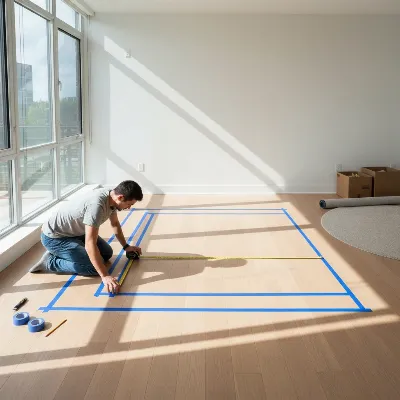 A homeowner uses blue painter's tape to outline the footprint of a sectional sofa on a living room floor, with a tape measure extended to verify dimensions, natural light, realistic style
Step 4: Account for Crucial Clearances and Walkways
A sectional might fit, but can you live with it comfortably? Ensure adequate space for movement and other furniture. Aim for at least 30-36 inches (75-90 cm) of clear space around the sectional for main walkways and to allow easy access to doors and other areas. If you plan on having a coffee table, leave a minimum of 18 inches (45 cm) between the sectional’s edge and the table for comfortable legroom and access. Furthermore, it’s advisable to leave 1-2 inches (2.5-5 cm) between the sectional and the wall to prevent damage to both the furniture and your paint.
Step 5: Measure the Delivery Path
This step is often overlooked but is absolutely critical. Even if the sectional fits perfectly in your living room, it needs to get there. Measure every doorway (width and height, accounting for the door swing and hinges), hallway (especially at its narrowest points), and stairwell (width, rise, landing lengths, and ceiling clearances) that the sectional will need to pass through. If using an elevator, measure its interior dimensions. Always compare these measurements to the largest individual piece of your chosen sectional to ensure it can be maneuvered without difficulty. Many delivery services require specific clearances, and knowing these beforehand can save you immense stress on delivery day.
Understanding Sectional Sofa Dimensions
When you’re browsing for sectionals, you’ll encounter various dimensions. Knowing what each measurement signifies will help you match the sofa to your meticulously measured space.
- Overall Length/Width: For an L-shaped sectional, you’ll see two length measurements (e.g., 96″ x 120″), representing the longest horizontal dimensions of each side. For U-shaped, there will be three. This is the total measurement from one outer edge to the other along each primary side.
- Depth: This refers to the measurement from the front of the seat to the very back of the sofa. Standard depths are typically 36-40 inches, while oversized options can be up to 45 inches.
- Height: Measured from the floor to the highest point of the backrest. This is important for aesthetic balance and ensuring it doesn’t block windows or artwork.
- Chaise Length: If your sectional includes a chaise lounge, note its specific length, usually ranging from 60-72 inches. This greatly impacts the overall footprint.
- Modular and Curved Sectionals: Modular sectionals offer flexibility as individual pieces can be rearranged. When measuring for a curved sectional, imagine it fitting inside an invisible rectangle and measure the widest point from end to end and the deepest point from front to back to get its “bounding box” dimensions.
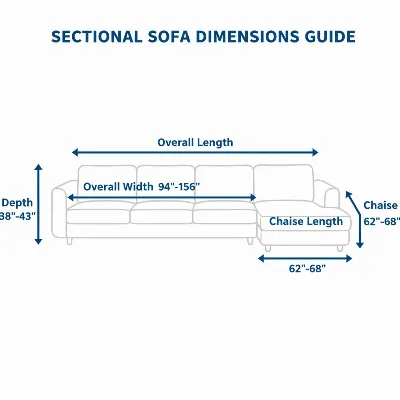 An infographic illustrating key sectional sofa dimensions like overall length, width, depth, and chaise length with arrows and labels, clear background, graphic design style
> “The biggest mistake people make is falling in love with a sectional online without ever pulling out a tape measure. Visualize, tape it out, then buy.” – Emily R., Lead Interior Designer, Luxe Living Spaces
Conclusion
Measuring your room for a new sectional sofa might seem like a daunting task, but with a systematic DIY approach, it becomes an empowering step towards creating your ideal living space. By carefully mapping your room, recording dimensions, visualizing with painter’s tape, and accounting for crucial clearances and delivery paths, you ensure that your sectional sofa is a perfect fit. Remember, a well-measured room guarantees a functional, comfortable, and aesthetically pleasing outcome. So, grab your tape measure, sketch your space, and get ready to welcome the sectional of your dreams! What part of measuring for a sectional do you find most challenging?
Câu Hỏi Thường Gặp
How much clearance should I leave around a sectional sofa?
It is best to leave a minimum of 30 to 36 inches (75 to 90 cm) of clear walkway space around your Sectional Sofa. This ensures comfortable movement and prevents the room from feeling cramped or obstructing natural traffic flow.
What are standard sectional sofa dimensions?
While there are no universally fixed “standard” dimensions due to their customizable nature, many sectionals typically range from 94 to 156 inches in overall length. Depths usually fall between 36-40 inches for standard designs, extending up to 45 inches for oversized models.
How do I measure for sectional sofa delivery?
Measure the width and height of all doorways, hallways, and stairwells the sectional will pass through. Crucially, measure the diagonal depth of the largest sectional piece to ensure it can be angled through narrower openings.
What if my room is small for a sectional?
For smaller rooms, consider compact L-shaped sectionals or modular designs without armrests, which offer greater flexibility. Focus on maximizing seating along a primary wall and ensure ample walkway clearances (30-36 inches) to maintain an open feel.
Should I measure my room wall-to-wall for a sectional?
No, it’s generally not recommended to measure wall-to-wall unless you intend for the sectional to fill the entire space. Always leave breathing room for end tables, lamps, vents, and especially for walkways to ensure the room remains functional and comfortable.