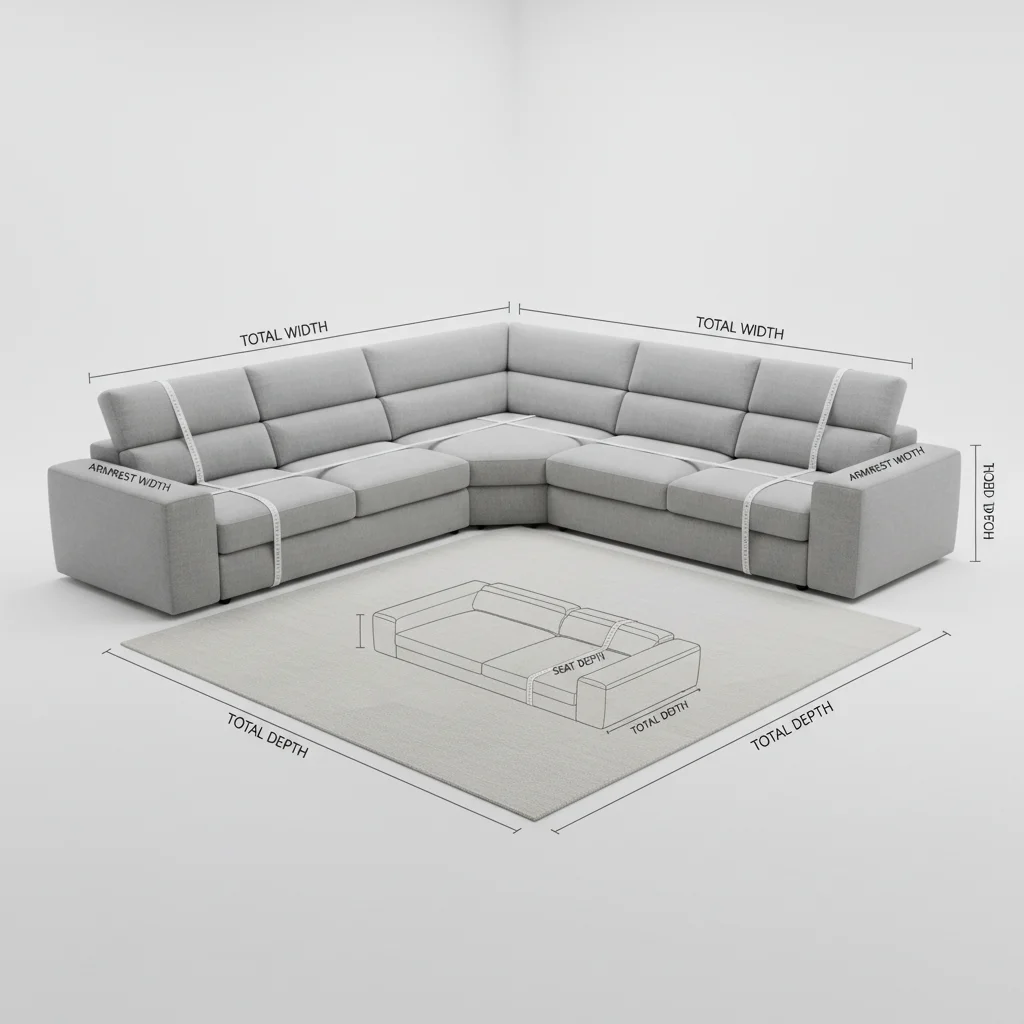
Understanding sectional sofa dimensions is crucial for ensuring your new furniture fits perfectly into your living space. There are typically three key measurements to consider: overall width, depth, and height. By accurately measuring these, you can avoid common pitfalls like blocking walkways or overwhelming a room.
Why Accurate Measurements Matter for Sectional Sofas
Accurate measurements prevent costly returns and ensure your sectional enhances, rather than hinders, your room’s flow. A sectional that’s too large can make a small room feel cramped, while one that’s too small might look out of place in a spacious area. Consider not just the floor space, but also the height relative to windowsills or wall art, and the depth in relation to coffee tables or other furniture.
It’s also important to account for doorways, hallways, and stairwells when planning delivery. Many sectionals come in multiple pieces, which can simplify delivery, but knowing the largest component’s dimensions is still vital.
How to Measure Your Room for a Sectional Sofa
Start by mapping out the desired placement of your sectional. Use painter’s tape on the floor to outline the footprint. Measure the length and width of this area. Don’t forget to measure the distance from the wall to any existing furniture or architectural features like fireplaces. For depth, consider how far the sofa will extend into the room and if it will impede traffic flow. For height, measure from the floor to the bottom of any windows or wall-mounted items.
- Measure the total length of the wall where the sectional will sit.
- Measure the depth from the wall into the room, considering walking paths.
- Measure the height from the floor to any obstructions like windows or shelves.
- Account for door frames and hallways for delivery access.
- Consider the orientation (L-shape, U-shape) and how it impacts room flow.
Understanding Common Sectional Sofa Configurations
|
Our Picks for the Best Sectional Sofa in 2026
As an Amazon Associate I earn from qualifying purchases.
|
||
| Num | Product | Action |
|---|---|---|
| 1 | Modular Sectional Sofa Couch with Storage Space Underneath, 93''L 3 Seater Sofa with Deep 27'' Seat & Rolled Armrest Design, Wood Frame Seat with Dual Spring and Memory Foam Cushion |

|
| 2 | 108" L Shaped Modular Sectional Cloud Couch with Ottoman, 3 Seats Modern Sofas with Charger, USB & Type-c Port with Deep Seat for Living Room, Bedroom and Apartment, White |
|
| 3 | Modway EEI-4112-CHA Restore 3-Piece Sectional Sofa, Charcoal |
|
| 4 | Modway Roscoe Left-Facing Sectional Sofa with Chaise in Ivory - 2-Piece Mélange Chenille Fabric Deep Seat Couch, L Shaped Modular for Living Room or Lounge |
|
| 5 | ZeeFu Convertible Sectional Sofa Couch,Classic 3 Seat L-Shaped Sofa with Movable Ottoman, Modern Dark Grey Velvet Fabric Upholstered Small Sectional Sofa Couch for Small Apartment Living Room Office |
|
| 6 | Modway Roscoe Right-Facing Sectional Sofa with Chaise in Espresso - 2-Piece Faux Leather Upholstered Deep Seat Couch, L Shaped Modular for Living Room or Lounge |
|
| 7 | Modern Luxury Curved Sectional Sofa for Living Room,168-inch Oversized 3-Piece White Boucle Fabric U-Shaped Couch Indoor,Upholstery Modular Semicircle Chaise |
|
| 8 | arabicsofa 4" Thick L Shaped Floor Couch, Seating, Floor Pillow, Sectional Sofa Set, Patio Furniture, Arabic Majlis (L Sofa + Rug + Ottoman, 4'' Thickness (10 cm)) |
|
| 9 | L Shaped Arabic Floor Cushions, Sectional Sofas, Arabic Majlis Set, Custom Made Sofa, Arabic Sofa Set, Seating Cushions (4'' Thickness Sofa, L Sofa + Rug, Green) |
|
| 10 | 140" U Shaped Modern Modular Sectional Sofa, Chenille Cloud Couch with Storage Ottoman, 4 Seater Deep Seat Couches with Side Pocket for Living Room, Bedroom and Apartment, Beige |
|
Sectional sofas come in various configurations, each with distinct dimensional considerations. L-shaped sectionals typically have two main sections, one longer than the other, forming an ‘L’. U-shaped sectionals, on the other hand, have three main sections, creating a ‘U’ shape, offering more seating. Modular sectionals provide the most flexibility, allowing you to arrange individual pieces to fit your space. Each configuration will have different overall width and depth requirements.
When looking at product specifications, pay close attention to the dimensions of each individual component, not just the overall footprint. This is especially important for modular designs where pieces can be rearranged.
Tips for Visualizing Your Sectional in the Space
Beyond tape, use cardboard boxes or old sheets to mimic the sectional’s dimensions in your room. This tactile approach helps you visualize the scale and ensure there’s enough clearance for walking, opening doors, and placing side tables. Take photos from different angles to review later. Consider the natural light and how the sectional might cast shadows or block views.
Think about how you’ll use the space. Will people be walking behind the sectional? Do you need space for a floor lamp? These practical considerations are just as important as the raw numbers.
What to Look for in Product Specifications
When reviewing product specifications online or in-store, always check for the overall dimensions (width, depth, height) and, if available, the dimensions of individual components. Pay attention to seat depth and height, as these impact comfort. Some manufacturers also provide armrest height and width, which can be important for fitting into tight spaces or under windows. Don’t hesitate to ask for detailed diagrams if they aren’t readily available.
Always double-check the measurements against your own, as slight discrepancies can occur. It’s better to be overly cautious than to receive a sectional that doesn’t fit.
Delivery and Assembly Considerations
Even if a sectional fits your living room, it still needs to get there. Measure all doorways, hallways, and stairwells that the furniture will pass through. If you live in an apartment, check elevator dimensions. Many sectionals are designed to be disassembled for easier transport, but some larger pieces might still pose a challenge. Confirm with the retailer about their delivery and assembly services, and whether they offer white-glove delivery that includes bringing the furniture into your home and setting it up.
Knowing the largest individual piece’s dimensions is critical for navigating tight turns and narrow passages. Don’t assume it will fit just because it’s a sectional; always measure the path it will take.
Get our weekly buyer guide
Practical specs, not advice. Unsubscribe anytime.
